
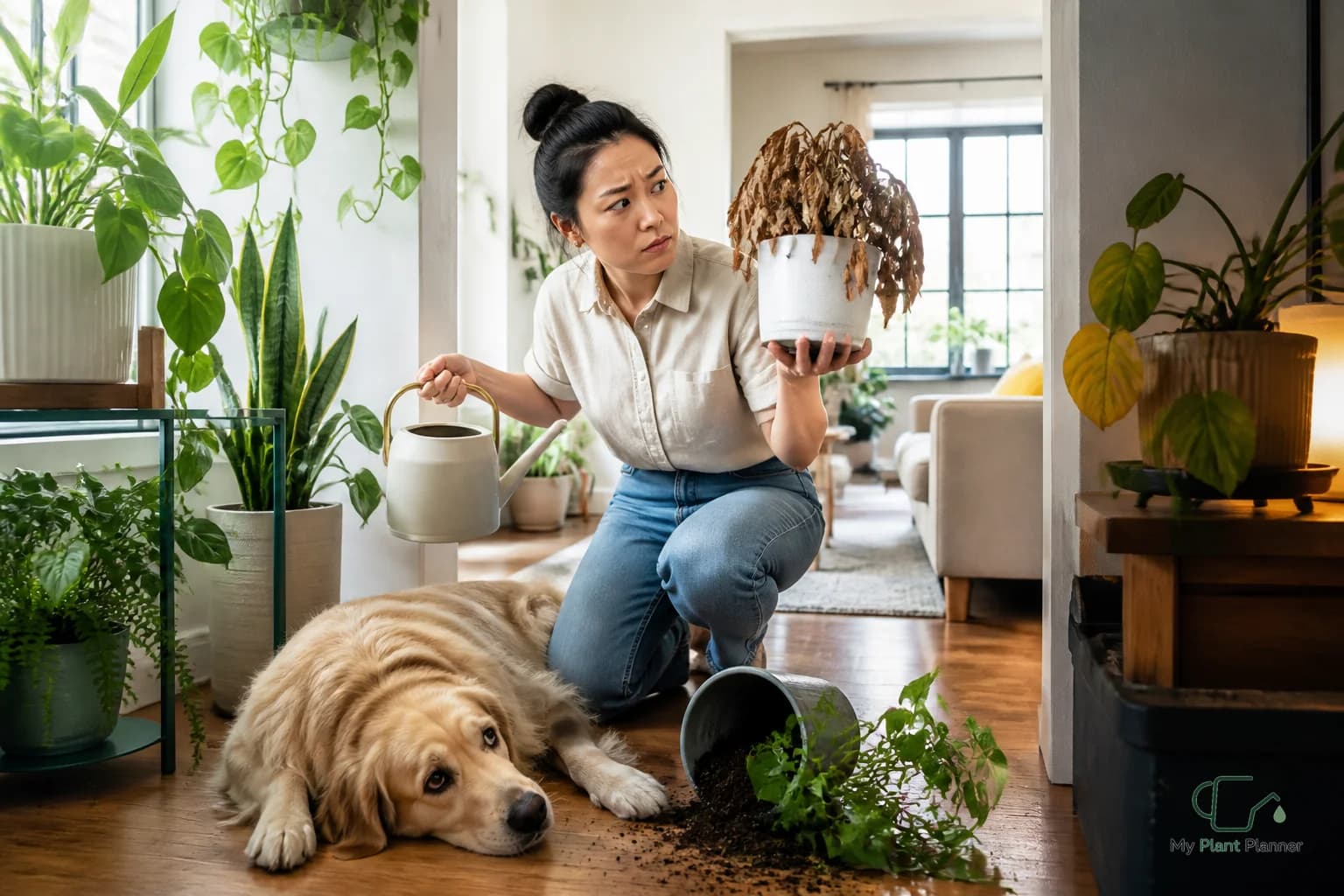
A watering routine can look perfectly reasonable on paper and still flop in real life.
You water two similar plants every seven days. One looks fine. The other gets soft, yellowing, crispy, or weirdly droopy. The easy answer is to blame yourself or the plant. The better answer is usually simpler: those plants are living in different rooms, and rooms dry soil at different speeds.
That is why the same watering schedule fails even when the plant names match: the room changes the soil, and the soil decides whether watering helps.
A calendar can remind you to check. It should not decide for the plant.
Watering schedules work better when they respond to the room instead of forcing every plant into the same date.
Short answer
The same watering schedule can fail in different rooms because water use is not controlled by plant type alone. Light level, pot size, soil volume, drainage, airflow, temperature, humidity, and season all change how fast the pot dries.
So instead of saying, water this plant every Saturday, use a starting check window.
For example, if a plant usually needs checking every 7 to 10 days in bright indirect light, that same plant may need a longer check window in a dim bedroom and a shorter one near a warm, bright window. You still check the soil before watering. You are not trying to hit a perfect date. You are trying to catch the plant when the pot has dried enough for that plant type.
If you have been watering by habit, read Why watering houseplants once a week is often too much. Weekly watering is convenient for humans, not always for roots.
Why different rooms change the check window
A room is not just decor. It is a mini climate.
Light level: Brighter light usually means the plant uses more water and the soil dries faster. Lower light often slows growth and keeps soil wet longer. A plant in a north facing room may not drink like the same plant near an east or west window.
Pot size: A large pot holds more soil, which holds more water. If the root system is small compared with the pot, the middle and lower soil can stay wet while the top looks dry.
Pot material: Terracotta loses moisture faster than glazed ceramic or plastic. That does not make one better. It just changes the check window.
Drainage: A pot with no drainage hole is much less forgiving. Water has nowhere useful to go, so the lower soil can stay wet even when the surface looks harmless.
Airflow: A plant in a still corner dries more slowly than one in a room with gentle air movement. HVAC vents can also dry leaves and soil faster, sometimes unevenly.
Temperature and humidity: Warm, dry rooms usually pull moisture out of soil faster. Cool, humid rooms slow drying.
Season: In winter, many indoor plants slow down and use less water. In summer, brighter days and warmer rooms can shorten the check window.
For more on the biggest room factor, see How light level changes your indoor plant watering schedule.
What people get wrong
The first mistake is treating the plant name as the whole answer.
Snake plant, pothos, peace lily, monstera, ZZ plant, rubber plant. The name helps, but it is not enough. A pothos in a bright kitchen and a pothos on a dim bookcase are not living the same life.
The second mistake is checking only the surface of the soil. The top inch can dry while the lower pot stays wet. This is especially common in larger pots, dense soil, cachepots, and rooms with weaker light.
The third mistake is watering as soon as a leaf looks off. A droopy or soft leaf does not automatically mean the plant needs water. It can happen when roots are sitting too wet, when the room is hot, when the plant was recently moved, or when the pot has dried too far. The soil check comes before the watering can.
The fourth mistake is changing everything at once. If a plant looks unhappy, people often water more, move it, repot it, mist it, and fertilize it in the same week. Now you have five variables and no idea which one helped or hurt.
Questions to check before watering
Before you water a plant that is on the same schedule as another plant, pause for 30 seconds and ask:
- Is this room brighter or dimmer than the other room?
- Is the plant in a larger pot than the other one?
- Does the pot have a drainage hole?
- Is the plant sitting inside a decorative outer pot that could hold runoff?
- Is the room warmer, cooler, drier, or more humid?
- Has the season changed since this schedule started?
- Does the soil feel dry only on top, or deeper down too?
- Did the plant dry at this pace for the last two watering cycles, or is this new?
That last question is useful. One weird week can happen. A pattern over two or three cycles is more useful than one dramatic leaf.
Simple room by room checklist
Use this checklist when two similar plants are behaving differently.
- Pick one plant and note its room, light level, pot size, pot material, and drainage.
- Check the soil depth, not just the surface. Use a finger, wooden chopstick, or moisture meter as a rough guide.
- If the lower soil is still damp, wait and check again in a few days.
- If the soil is dry to the depth that fits that plant type, water thoroughly and let excess drain away.
- Empty any saucer or outer pot after watering so the plant is not sitting in runoff.
- Write down when you checked, whether you watered, and what the soil felt like.
- Repeat for two cycles before making a big schedule change.
- Adjust the check window by a few days, not by panic.
This is boring in the best way. Plants usually reward boring care more than dramatic rescue missions.
How to adjust without overcorrecting
If the plant in the dimmer room is staying wet too long, widen the check window. Instead of checking every 7 days, try checking around day 10 or 12. Do not ignore it for a month. Just stop forcing the brighter room schedule onto it.
If the plant in the brighter or warmer room is drying faster, shorten the check window. Check a few days earlier and confirm the soil before watering.
If the plant is in a pot much larger than its root ball, be extra careful. The top may tell one story and the bottom may tell another. Watering less often may help, but drainage and soil structure matter too.
If the plant has no drainage, be conservative. It is much easier to add a little water later than to remove water trapped at the bottom of a closed pot.
A calmer way to think about watering
A watering schedule is not a promise. It is a reminder to inspect the plant and the pot.
The goal is not to copy one routine across every room. The goal is to build a check window that fits the plant, the light, the pot, the season, and the indoor climate. Start with a reasonable window, check the soil, water only when the pot is ready, then adjust after a couple of cycles.
If two plants on the same schedule are giving you different results, do not assume one of them is being difficult. The room may be quietly changing the rules.
Want a starting check window tailored to your plant, light, pot, season, and indoor climate? Try My Plant Planner: https://myplantplanner.com/?utm_source=mdx.
Practical note
This article is general indoor plant care information. Watering windows are starting points, not guarantees. Your plant, pot, soil, light, season, and home climate can all change the right timing.
My Plant Planner gives general indoor plant-care guidance. Always check soil and plant condition before watering.