Most plant owners do not underwater on purpose. They water because the plant looks sad, limp, pale, curled, or dramatic. Fair enough. Plants are not exactly great communicators.
But indoor watering gets messy because the same stressed look can come from opposite problems. A plant with dry roots may droop. A plant with roots sitting too wet may also droop. If you respond to every sad leaf with more water, you can turn a small problem into a bigger one.
The first way to tell whether watering is making things worse is to compare the stressed leaves with the soil and pot, not with the calendar.
The direct answer
Watering may be making your houseplant worse when the plant looks stressed but the root zone is still damp, the pot still feels heavy, or water has been sitting in a saucer or decorative outer pot.
That does not mean the plant is doomed. It means water is not the next automatic move.
Before watering again, check moisture below the surface, not just the top layer. The top can dry fast while the lower soil stays wet. If the lower soil is still damp, wait and improve the conditions around the plant: brighter appropriate light, better drainage, less standing water, and a longer watering check window.
For a deeper symptom comparison, see Overwatering signs in common houseplants and Underwatering signs in common houseplants.
What to check before you water again
A good watering decision is not based on one leaf. Use a few clues together.
Soil moisture below the surface: Push a finger, wooden skewer, or moisture probe into the soil. For many common tropical houseplants, the top inch drying out is not always enough. For drought tolerant plants, you may need much more of the pot to dry before watering.
Pot weight: A wet pot is noticeably heavier than a dry one. Lift the pot after watering, then lift it again several days later. This is one of the simplest ways to learn your plant's rhythm.
Drainage: If water cannot leave the pot, your schedule does not matter much. A pot without a drainage hole, compacted soil, or a saucer that stays full can keep roots wet longer than expected.
Light level: Low light slows water use. A plant in a darker corner may need a much longer check window than the same plant near bright indirect light.
Plant type: A peace lily, pothos, snake plant, and fern should not be treated like they all have the same thirst. Thick leaves, rhizomes, bulbs, and succulent stems often mean the plant can wait longer.
Season and indoor climate: Air conditioning, heating, humidity, and seasonal growth all change how fast a pot dries. The calendar is less useful than what the soil and plant are doing.
Common mistakes that make watering stress worse
The biggest mistake is treating visible stress as a water order. Drooping, curling, yellowing, and soft leaves can happen for more than one reason. Water is only helpful when the plant can actually use it.
Another common mistake is giving tiny sips over and over. This can keep the top layer damp while leaving the lower root area uneven. When a plant is ready for water, water thoroughly until excess drains out, then let the pot move back toward the right dryness range for that plant.
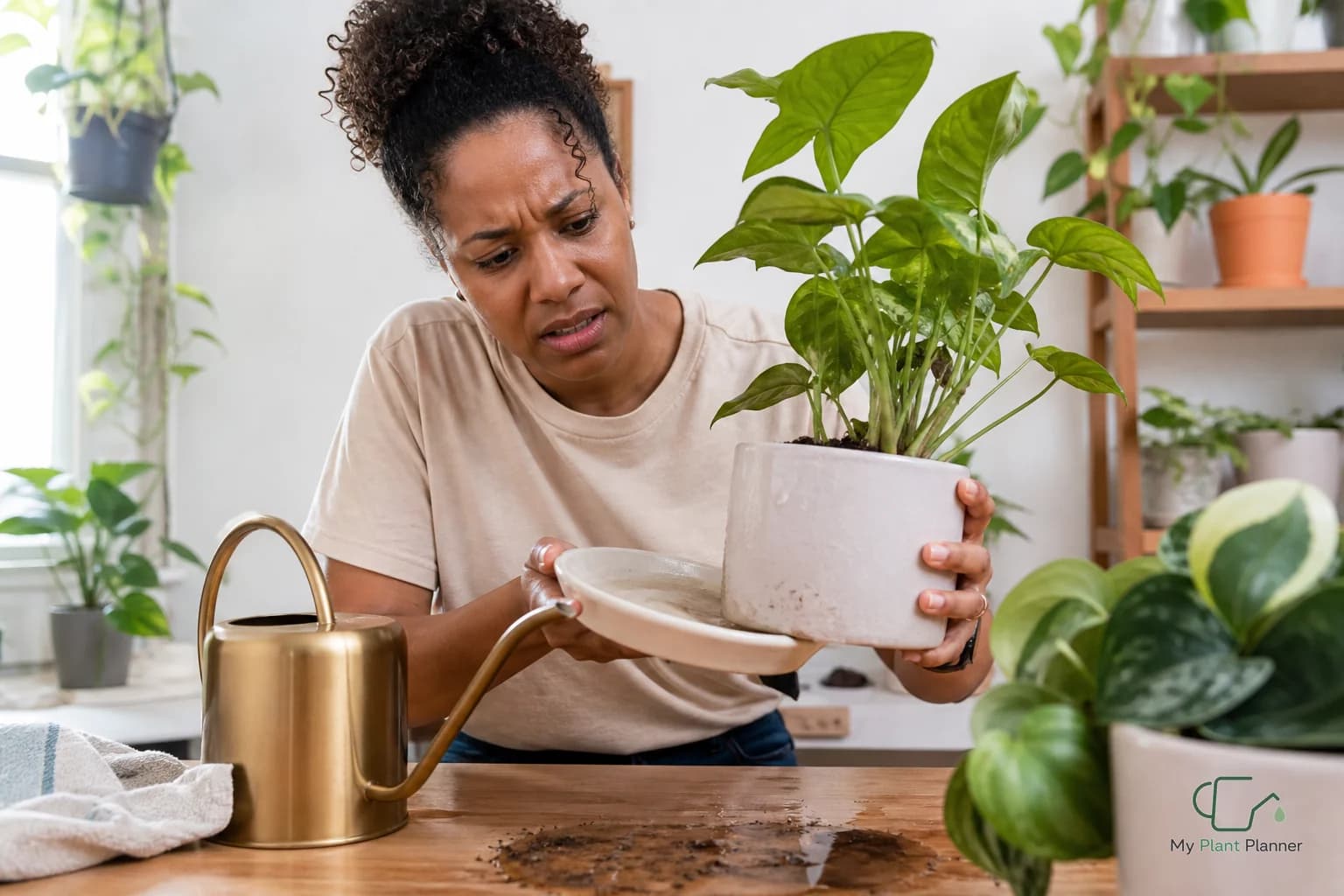
People also forget about the outer pot. A nursery pot sitting inside a decorative cachepot can drain perfectly and still sit in a hidden puddle. Check underneath before assuming the soil is drying normally.
Then there is the weekly watering trap. Once a week sounds tidy, but plants do not care about your calendar. A small pothos in bright light may dry faster than expected. A large snake plant in a glazed pot across the room may stay damp for ages.
The final mistake is changing everything at once. More water, new soil, fertilizer, pruning, and a new location in the same afternoon can make it harder to know what actually helped. Adjust one or two basics first.
Questions to ask before pouring
Use these questions when a houseplant looks rough and you feel tempted to water immediately.
- When did I last water this plant?
- Is the soil dry only on top, or dry deeper in the pot?
- Does the pot feel light, medium, or still heavy?
- Did water drain out last time?
- Is there water sitting in the saucer or outer pot?
- Has the plant recently moved to lower light?
- Is the room cooler, more humid, or less sunny than usual?
- Is this plant naturally drought tolerant, moisture loving, or somewhere in the middle?
- Did the plant decline right after watering, or after a long dry stretch?
- Have I checked the same way for more than one watering cycle?
You are not looking for a perfect answer. You are looking for enough evidence to avoid the wrong next step.
A simple reset checklist
If your plant looks stressed and you are not sure whether to water, use this checklist.
- Check soil moisture below the surface, not just the top.
- Lift the pot and notice whether it still feels heavy.
- Empty any water from the saucer or decorative outer pot.
- Make sure the pot has a working drainage hole.
- Move the plant into suitable brighter light if it has been sitting too dark.
- Wait if the lower soil is still damp.
- Water thoroughly only when the soil dryness matches that plant's needs.
- Do not add fertilizer to a stressed plant just to do something.
- Track what happens over the next one or two watering cycles.
- Adjust the check window instead of forcing a fixed weekly schedule.
A check window might be every 5 to 7 days for one plant and every 14 to 21 days for another. The point is not to water on that day no matter what. The point is to check then, read the soil, and decide.
A calmer way to handle a stressed plant
When a plant looks unhappy, it is tempting to act fast. Sometimes that helps. Sometimes it is just panic with a watering can.
Slow down for two minutes. Check the soil depth, pot weight, drainage, and recent watering history. If the root zone is still damp, waiting is often the more careful move. If the pot is dry through the right range for that plant, water thoroughly and let it drain.
Your goal is not a perfect schedule. It is a repeatable watering check window that gets smarter after a couple of cycles.
If you want a simple starting point based on plant type, light, pot size, season, and indoor climate, use My Plant Planner to build a practical watering check window.
Practical note
This article is general indoor plant care information. Watering windows are starting points, not guarantees. Your plant, pot, soil, light, season, and home climate can all change the right timing.
My Plant Planner gives general indoor plant-care guidance. Always check soil and plant condition before watering.