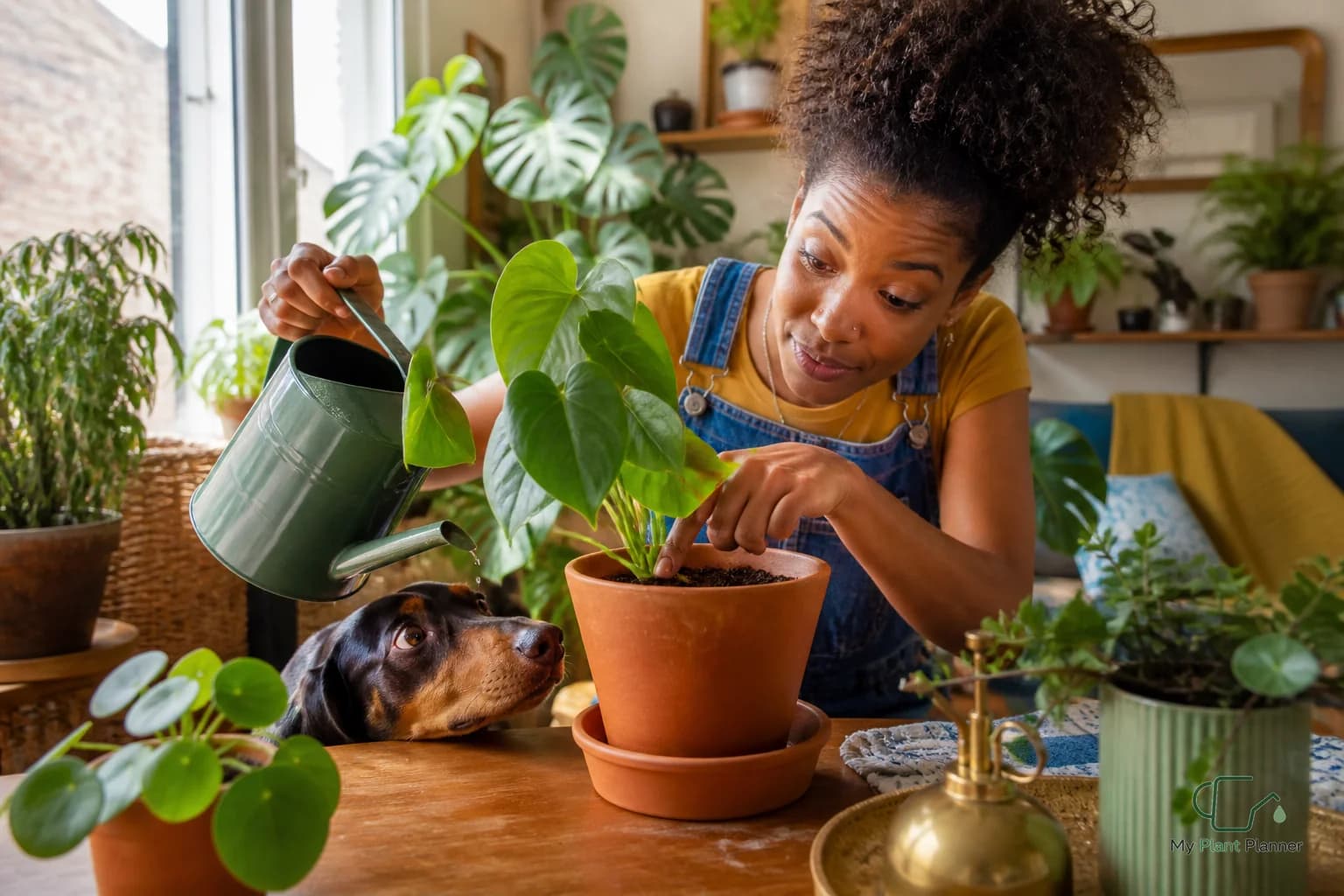
If your houseplants swing between limp, yellow, crispy, and somehow still damp, the problem may not be that you are bad at plant care. It may be that your watering plan is too rigid.
A calendar reminder is useful. A calendar command is not. Indoor plants do not care that it is Sunday. They care how much light they got, how much water the pot held, how warm the room was, and whether the roots had enough air.
Direct answer
Set a watering check window instead of a fixed watering date.
A watering check window is a short range of days when a plant is likely to be ready for water. When that window arrives, you check the soil and pot first. If the plant is dry enough for its type, you water. If the soil is still damp, you wait and check again later.
That small shift prevents a lot of beginner plant drama. You are not ignoring the plant. You are refusing to water blindly.
For more detail on soil cues, read How to tell if an indoor plant needs water.
What a watering check window actually means
A check window is not a promise. It is a starting point.
For example, a thirsty plant in bright indirect light and a small pot may need checking much sooner than a drought tolerant plant in low light and a large pot. Both can be healthy. They are just living in different conditions.
The goal is to answer one question: when is it worth checking this plant again?
That is different from asking: what exact day should I water forever?
The forever version is how people end up watering a damp pot because an app, tag, or sticky note said so.
The context factors that move the window
Start with these five factors.
Plant type
Some plants prefer to dry more between waterings. Snake plants, ZZ plants, aloe, and many succulents usually hate being kept constantly wet.
Others, like peace lilies and many tropical foliage plants, often want a more even moisture pattern. Even then, evenly moist does not mean soggy.
Light level
Light drives water use. A plant in brighter light usually drinks and dries faster than the same plant in a dim corner.
If you move a plant away from a window, the old watering rhythm may become too aggressive. If you move it into brighter light, the old rhythm may leave it dry sooner.
For a deeper breakdown, see How light level changes your indoor plant watering schedule.
Pot size
Large pots hold more water for longer. Small pots dry faster. This sounds obvious, but it catches people constantly because the plant above the soil may look small while the pot below it is doing most of the watering math.
A small plant in a large pot is easy to overwater because the roots may not use moisture as fast as the soil stores it.
Drainage and soil mix
A pot with drainage gives extra water somewhere to go. A pot without drainage turns every watering into a riskier guess.
Dense soil also stays wet longer than chunky, airy soil. If water sits in the saucer or cachepot, the check window needs to stretch longer until the setup is fixed.
Season and indoor climate
Warm rooms, fans, air conditioning, heaters, and dry air can all change how quickly a pot dries. Winter often slows growth and water use, especially when light drops.
Your plant may need one check window in summer and a slower one in winter. That is normal.
Common mistakes that make watering harder
The biggest mistake is watering all plants on the same day because it feels efficient. Efficient for you, maybe. Not always safe for the plant.
Other common traps:
- Watering because the top of the soil looks pale, without checking below the surface
- Giving a small splash every few days instead of watering thoroughly when the plant is ready
- Keeping a plant in a decorative pot with no drainage and using the same timing as a drained pot
- Assuming drooping always means thirst
- Treating yellow leaves as proof that more water is needed
- Forgetting to change the window after moving the plant to a brighter or darker spot
A lot of overwatering starts with good intentions. People see a stressed plant and try to help by adding water. Sometimes that is exactly the wrong move.
Questions to check before watering
Before you water, ask these:
- Is the top layer dry, or is it only dry on the surface?
- How far down does the soil still feel damp?
- Does the pot feel lighter than it did after the last full watering?
- Is the plant in bright light, medium light, or low light right now?
- Is the pot oversized for the plant?
- Does the container have drainage holes?
- Is water sitting in the saucer or outer pot?
- Has the season, room temperature, or airflow changed recently?
- Did the plant dry too fast or stay wet too long during the last two cycles?
You do not need perfect notes. A simple pattern is enough.
A simple watering check window checklist
Use this as your starter system:
- Pick a starting check window based on the plant type, light, pot size, season, and drainage.
- When the window arrives, check the soil before reaching for water.
- Use your finger, a wooden chopstick, or pot weight to judge moisture below the surface.
- If the soil is still damp for that plant type, do not water yet.
- If the soil is dry enough, water thoroughly until excess drains out.
- Empty the saucer or outer pot after watering.
- Write down whether the plant was ready, too wet, or very dry.
- After two or three cycles, shorten or stretch the window.
That last step is where the plan gets smarter. Your first window is a guess. Your next window is based on evidence.
When to shorten or stretch the window
Shorten the check window if the plant is consistently bone dry before you check, especially if the leaves are losing firmness and the pot feels very light.
Stretch the window if the soil is still damp every time you check, the pot feels heavy for days, or the lower leaves are yellowing while the soil stays wet. Those signs do not prove one single cause, but they are enough to pause before adding more water.
If a plant looks stressed and the soil is wet, watering again is usually the gamble. Check drainage, light, and pot size before assuming the plant needs more.
A calmer way to water
Good watering is not about finding one magic interval and obeying it forever. It is about checking at the right time and adjusting when your home changes.
A check window gives you structure without pretending every plant dries at the same speed.
If you want a starting point for your own plant, use the My Plant Planner watering calculator: https://myplantplanner.com/?utm_source=mdx. It gives you a practical check window based on your plant, pot, light, season, and indoor climate, then you can adjust after a couple of real watering cycles.
Practical note
This article is general indoor plant care information. Watering windows are starting points, not guarantees. Your plant, pot, soil, light, season, and home climate can all change the right timing.
My Plant Planner gives general indoor plant-care guidance. Always check soil and plant condition before watering.