
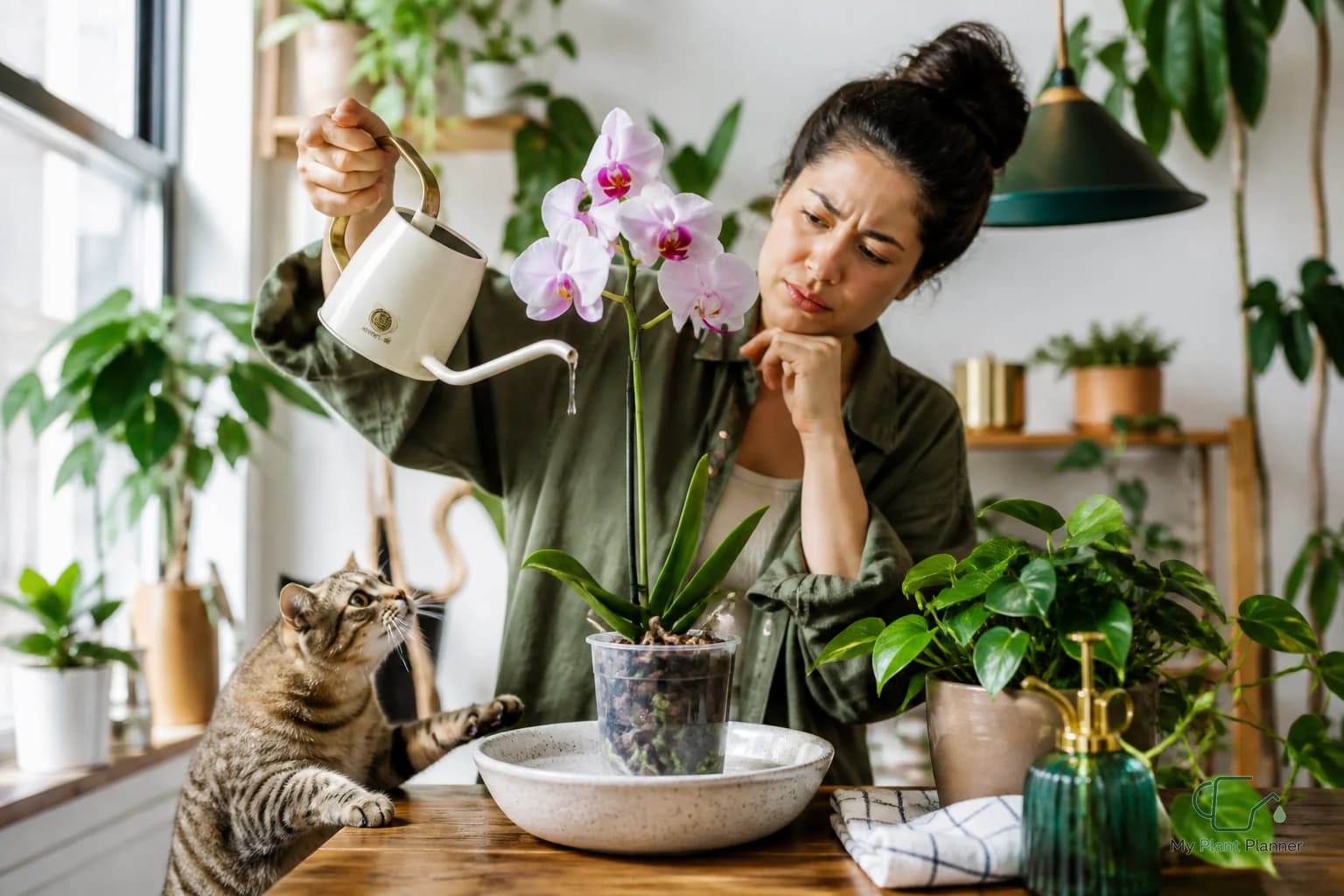
Most indoor orchid watering advice gets weird fast. Ice cubes, exact weekday routines, soaking rituals, misting drama. For a beginner with one grocery store moth orchid on a windowsill, that is a lot.
The better move is simpler: set a watering check window, inspect the roots and potting mix, then adjust after a couple of cycles.
This guide is for common indoor moth orchids, usually sold as Phalaenopsis orchids. Other orchids can behave differently, so do not treat this as a universal orchid rule.
Direct answer
For a moth orchid indoors, start by checking for water about every 7 to 10 days in average indoor conditions.
That does not mean watering every 7 to 10 days no matter what. It means that is a reasonable first check window.
Water when the potting mix is close to dry and the visible roots look silvery or pale green instead of plump bright green. If the mix still feels damp, the pot feels heavy, or the roots still look green and wet, wait a few more days and check again.
In brighter, warmer rooms, some orchids may need checking closer to every 5 to 7 days. In cooler rooms, lower light, large decorative pots, or dense moss, they may go 10 to 14 days or longer between waterings.
The tradeoff is simple: orchids hate drying into a crisp for too long, but soggy roots are usually the bigger indoor mistake.
What changes an orchid watering window
Orchids are not watered like most leafy houseplants because they are often planted in bark, moss, or a chunky orchid mix instead of normal potting soil.
A few factors change the window fast.
Potting mix
Bark dries faster and lets more air reach the roots. Sphagnum moss holds water longer. If your orchid is packed tightly in moss, the surface may look dry while the center is still damp.
That is where a fixed weekly pour can backfire.
Pot type
Clear plastic nursery pots are useful because you can see root color and condensation. A cachepot or decorative outer pot can trap extra moisture if water collects at the bottom.
If your orchid sits inside a pretty pot with no drainage, remove it to water and let it drain fully before putting it back.
Light level
A moth orchid in bright indirect light usually dries faster than one sitting far from a window. Lower light means slower growth and slower water use.
If you moved your orchid from a bright kitchen to a dim bedroom, the old watering rhythm may now be too wet.
Season and indoor climate
Warm rooms, fans, dry winter heat, and active growth can shorten the window. Cool rooms, cloudy weeks, and lower winter growth can stretch it.
If your home changes with the seasons, your orchid watering should change too.
Common orchid watering mistakes
The first mistake is treating orchids like regular soil plants. Orchid roots need air. If the potting mix stays wet and airless, more water will not help a struggling plant.
The second mistake is giving tiny sips. A few tablespoons of water can wet the top while leaving parts of the root zone uneven. When the orchid is actually ready, water thoroughly and let the pot drain.
The third mistake is trusting the calendar more than the plant. A Sunday watering habit feels organized, but orchids do not care what day it is.
The fourth mistake is assuming flowers mean the watering plan is perfect. Flowering orchids can still be sitting in poor moisture conditions. Blooms are nice, but roots tell you more about watering.
The fifth mistake is leaving drainage water in the decorative pot. That turns a normal watering into a root soak the plant did not ask for.
If your plant keeps looking thirsty while the potting mix is wet, read Why your houseplant looks thirsty when the soil is still wet. The same trap happens with orchids, even though the potting mix is different.
Questions to check before watering
Before you water, slow down and ask:
- Are the roots green and plump, or pale and silvery?
- Is there condensation inside the clear pot?
- Does the pot feel surprisingly heavy?
- Is the orchid in bark, moss, or a mix of both?
- Is water sitting inside the decorative outer pot?
- Has the room been cooler, darker, or cloudier than usual?
- Did the last watering take more than a week to dry down?
One answer does not decide everything. You are looking for a pattern.
Green roots, visible moisture, and a heavy pot usually mean wait. Silvery roots, little condensation, and a lighter pot usually mean it is time to water.
If you want a broader way to think about timing, see How to set a watering check window for indoor plants.
A simple orchid watering checklist
Use this as a starting routine for a common moth orchid indoors:
- Start with a 7 to 10 day watering check window.
- Look at the roots through the clear pot if possible.
- Water when roots are mostly silvery and the mix is close to dry.
- Take the orchid out of any decorative pot before watering.
- Water thoroughly so moisture reaches the root zone.
- Let water drain completely through the nursery pot.
- Empty any saucer or outer pot before putting the orchid back.
- Do not water again just because the surface looks dry.
- Shorten the check window in brighter, warmer, drier rooms.
- Lengthen the check window in cooler, darker rooms or dense moss.
- Recheck your pattern after two or three watering cycles.
If your orchid is in very tight moss and stays damp for a long time, be extra cautious. The center may remain wet even when the top looks dry.
What about ice cubes?
Ice cube watering is popular because it feels controlled. The problem is that it teaches people to think in tiny fixed doses instead of checking the pot.
Some orchids survive it. That does not make it the clearest beginner method.
A better habit is to learn what a ready to water orchid looks and feels like, then water thoroughly and drain fully. You get more information, and the roots get a clearer wet and dry cycle.
Adjust after a couple of cycles
Do not expect the first window to be perfect. Indoor watering is always a starting guess.
If the pot is still damp every time you check, stretch the window. If the roots are staying silvery for days and the leaves are losing firmness while the mix is dry, check sooner.
Avoid making a new rule after one weird week. Watch two or three cycles, then adjust.
Your goal is not to hit an exact watering date. It is to stop guessing blindly.
For a calmer way to build a plant specific check window, try My Plant Planner at https://myplantplanner.com/?utm_source=mdx.
Practical note
This article is general indoor plant care information. Watering windows are starting points, not guarantees. Your plant, pot, soil, light, season, and home climate can all change the right timing.
My Plant Planner gives general indoor plant-care guidance. Always check soil and plant condition before watering.