
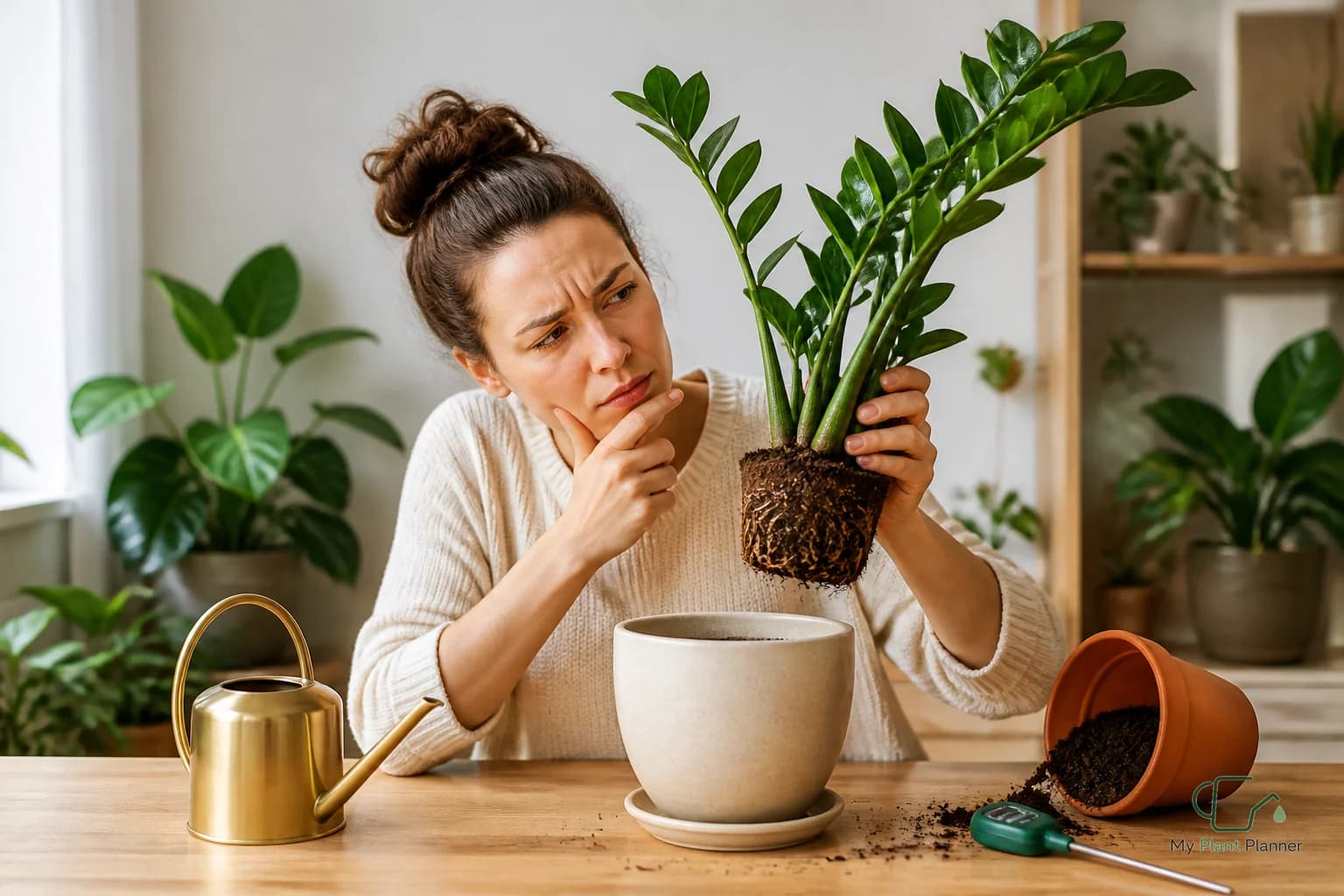
ZZ plants are popular because they forgive missed watering. They are less forgiving of a person who keeps topping them up because the top of the soil looks dry.
A ZZ plant stores water in thick underground rhizomes. That is the whole game. It can coast for a while without a drink, but it can struggle if the pot stays damp for too long. Your job is not to water it on a perfect date. Your job is to check at a sensible interval, then only water when the pot is ready.
The short version
For most indoor ZZ plants, start by checking the soil every 2 to 4 weeks during active growth.
Water when the soil is dry well down into the pot, not just dry on the surface. In low light, cool rooms, oversized pots, or winter, your check window may move closer to 4 to 6 weeks. In brighter indirect light, warm dry rooms, or smaller pots, it may be closer to 2 to 3 weeks.
That is a starting check window, not a promise. A ZZ plant in a nursery pot near a bright window will dry differently from one in a decorative ceramic pot across the room.
If you want a refresher on what dry soil actually feels like, use this guide: How to tell if an indoor plant needs water.
Why ZZ plants need less water than people think
ZZ plants have glossy leaves, thick stems, and chunky rhizomes under the soil. Those rhizomes act like storage tanks. When the soil dries out, the plant has reserves.
That is why weekly watering is often too aggressive for a ZZ plant indoors. A weekly schedule may work for a thirsty peace lily in bright light, but a ZZ plant is playing a slower game.
The tradeoff is simple. If you wait a little too long, a healthy ZZ plant often gives you time to correct. If you keep the soil wet for too long, the roots and rhizomes have less oxygen, and the plant can decline before a beginner realizes the pot has been staying damp.
The factors that change the watering window
Light level
More light usually means faster drying. A ZZ plant in bright indirect light may need checks more often than one in a dim hallway.
Low light does not mean no water. It means slower water use. If the plant is barely growing and the soil stays damp for weeks, do not force a watering routine just because the calendar says so.
For more context, see How light level changes your indoor plant watering schedule.
Pot size
An oversized pot can hold more moisture than the root system can use. That makes the plant look low maintenance while the lower soil stays wet.
A smaller pot with drainage often dries more predictably. A large decorative pot without drainage is where casual plant care gets expensive fast.
Soil mix
Dense, moisture holding soil stays wet longer. A lighter indoor potting mix with good drainage gives you more room for error.
You do not need to turn ZZ care into a lab project, but if the pot feels heavy for weeks after watering, the mix may be holding more water than the plant wants.
Season and room climate
ZZ plants often use less water in winter because days are shorter and indoor growth slows. Air conditioning, heating, humidity, and room temperature all change how fast the soil dries.
A plant near a warm bright window may dry faster than one in a cool bedroom, even if both are the same species.
Common ZZ plant watering mistakes
The big mistake is treating a ZZ plant like every other houseplant. It does not need to be included in a weekly watering lap just because you are already holding the watering can.
Another mistake is watering a little bit every few days. Small sips can keep the upper soil damp while deeper roots never get a proper soak. When the plant is actually ready for water, water thoroughly until excess drains out, then let the pot dry again.
People also trust the top inch of soil too much. With ZZ plants, the surface can look dry while the lower pot is still damp. Check deeper with a finger, wooden skewer, chopstick, or moisture meter used carefully.
And yes, drainage matters. A pot without a drainage hole can work for very careful growers, but it gives beginners almost no forgiveness. If water collects at the bottom, the plant cannot politely opt out.
Questions to ask before watering
Before you water your ZZ plant, ask:
- Does the pot still feel heavy from the last watering?
- Is the soil dry several inches down, not just on top?
- Is the plant in low light or a cool room?
- Is the pot much larger than the root ball?
- Is it winter or a slower growth period?
- Did you water recently because of a routine, or because the soil was actually dry?
If you are unsure, wait a few more days and check again. ZZ plants usually prefer that over being watered into damp soil.
A simple ZZ plant watering checklist
Use this as a calm starting routine:
- Check the soil every 2 to 4 weeks in spring and summer.
- Stretch the check window in winter, low light, or cool rooms.
- Feel several inches down, or test with a wooden skewer.
- Water only when the soil is dry well down into the pot.
- Water thoroughly when it is time, then let excess drain away.
- Empty any saucer or cachepot after watering.
- Do not water again just because the top looks dry.
- Adjust after two or three watering cycles in your actual room.
A cautious note on yellow leaves and drooping stems
Yellowing leaves, soft stems, drooping, or dry tips can point to watering stress, but they are not proof by themselves. Light, pot size, old leaves, root issues, temperature swings, and previous care can all muddy the picture.
Do not diagnose the plant from one symptom. Check the soil, pot weight, drainage, and your recent watering pattern first.
A ZZ plant is one of the better plants for beginners because it does not demand constant attention. The catch is that you have to let it be that kind of plant. Check on a reasonable schedule, water when the soil is truly dry, and adjust after a couple of cycles.
If you want a starting check window based on your plant, light, pot size, season, and indoor climate, try My Plant Planner.
Practical note
This article is general indoor plant care information. Watering windows are starting points, not guarantees. Your plant, pot, soil, light, season, and home climate can all change the right timing.
My Plant Planner gives general indoor plant-care guidance. Always check soil and plant condition before watering.