
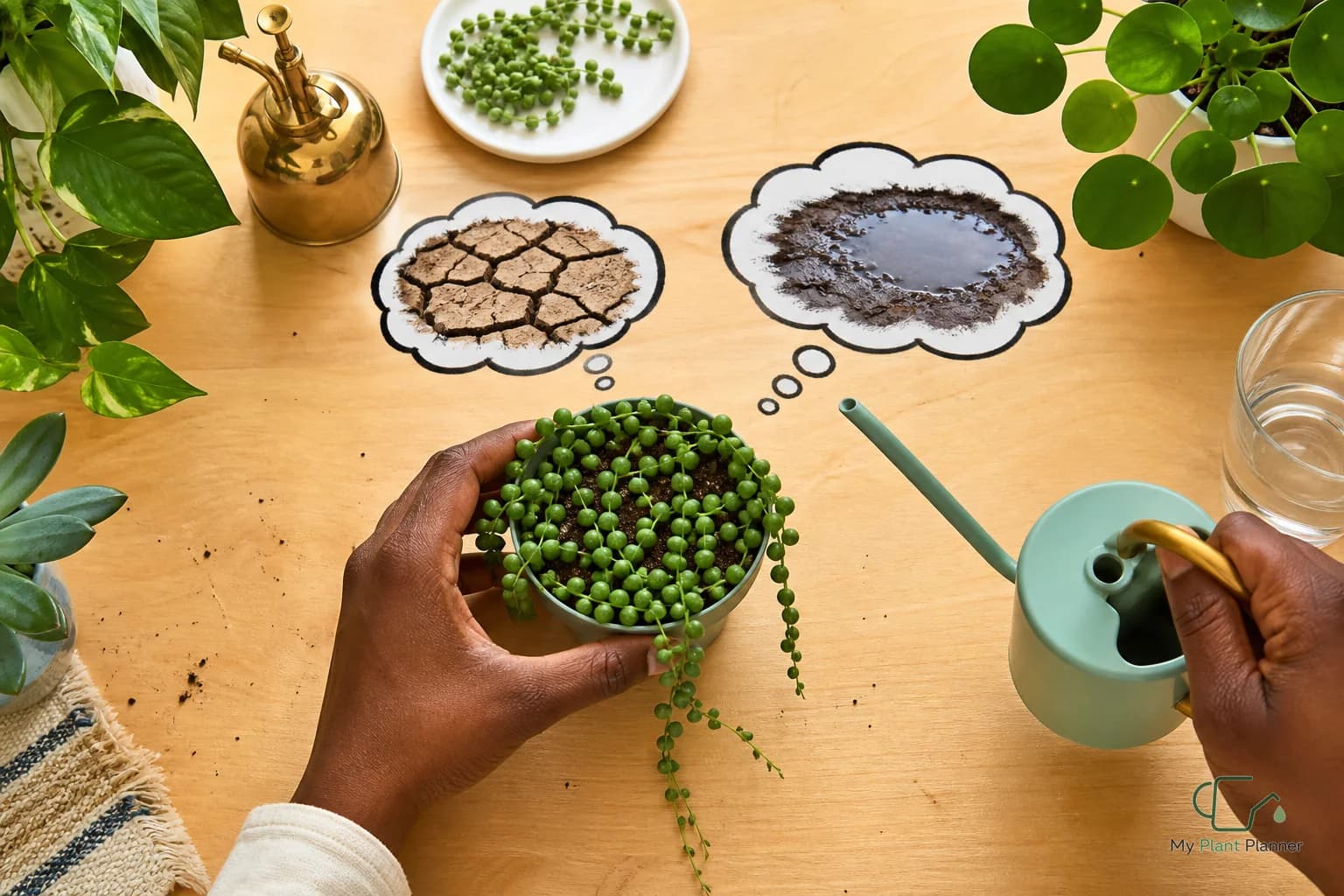
String of pearls looks delicate, but the watering mistake is usually not neglect. It is treating those little bead leaves like a fern, then wondering why the stems look tired.
This plant is a succulent. That means your job is not to keep the soil politely moist. Your job is to let it dry well, then water clearly when the plant and pot are ready.
Direct answer
For string of pearls indoors, start by checking for water about every 10 to 14 days in brighter spring and summer conditions. In fall and winter, or in a lower light room, the check window may stretch closer to every 2 to 4 weeks.
That is a starting check window, not a promise that the plant needs water on that day.
Water only when the potting mix is dry most of the way down, the pot feels noticeably lighter, and the pearls are starting to look a little less plump. If the soil still feels damp below the surface, wait.
String of pearls stores water in its round leaves. If you water just because the top looks dry, you can keep the lower mix wet while the plant is still fully stocked.
What changes the watering window
The same string of pearls can dry in 9 days in one home and 25 days in another. That is not plant drama. That is physics.
Light is the biggest factor. A plant near bright indirect light uses water faster than one sitting several feet from a window. Lower light slows growth and evaporation, so the soil stays damp longer.
Pot size matters too. A small, shallow pot usually dries faster. A large pot with a small root system holds extra wet mix around the roots. That extra buffer sounds helpful, but for a succulent it can be the reason watering feels impossible to get right.
Pot material changes the rhythm. Terracotta can dry faster because it breathes. Plastic, ceramic, and glazed pots tend to hold moisture longer. Neither is automatically good or bad. You just need to water for the pot you actually have.
Soil mix matters. String of pearls usually does better in a fast draining cactus or succulent style mix than in dense all purpose potting soil. If water hangs around for a week or more after every watering, the mix may be too heavy, the pot may be too large, or the light may be too low.
Season matters indoors, even if your thermostat stays boring. Shorter days usually mean slower growth. Slower growth means slower water use.
Common mistakes with string of pearls watering
The first mistake is watering weekly by default. Weekly watering can work for some thirsty plants in strong light, but string of pearls often does not need that much indoors.
The second mistake is misting instead of watering. Misting the strands does not properly hydrate the root ball. It can also leave moisture sitting around crowded stems. When the plant is ready, water the soil thoroughly, then let excess water drain.
The third mistake is giving tiny sips. A nervous splash every few days keeps the top layer damp while the lower root area may never get a clean soak. It also makes it harder to read the pot. A better pattern is dry well, water thoroughly, drain fully, then wait again.
The fourth mistake is using leaf texture alone. Slightly soft pearls can mean the plant is ready for water, but soft or shriveled growth can also show up when roots have been sitting too wet and are not taking water up well. Check the soil before deciding.
For a deeper look at that exact confusion, read Why overwatering and underwatering look alike indoors.
Questions to check before you water
Before you water a string of pearls, ask five quick questions.
Is the top layer dry only, or is the mix dry deeper down too?
Does the pot feel light compared with how it felt right after watering?
Are the pearls slightly less firm, or are they still round and full?
Has the plant been getting bright indirect light, or has it been sitting in a dim corner?
Did the last watering take a long time to dry out?
If the answers point in different directions, wait a day or two and check again. String of pearls usually handles a short wait better than another drink into damp soil.
Simple watering checklist
Use this as your basic routine.
- Check the plant every 10 to 14 days during brighter growing months.
- Check every 2 to 4 weeks during lower light or cooler months.
- Feel the soil below the surface, not just the top crust.
- Lift the pot and compare its weight to the just watered weight.
- Look for pearls that are slightly less plump, not badly collapsed.
- Water thoroughly when the mix is dry most of the way down.
- Let water drain out of the pot.
- Empty any saucer or cachepot so the roots are not sitting in runoff.
- Wait longer next time if the soil stayed wet for many days.
- Shorten the next check window slightly if the plant dried out much faster than expected.
If you are building a routine from scratch, How to set a watering check window for indoor plants is a good companion guide.
If your plant is in a hanging pot
Hanging string of pearls can be trickier because it is easy to judge the trailing strands and forget the root ball. The strands may look dramatic while the soil is still damp near the crown.
Take the pot down when you check it if you can do that safely. Feel the mix, lift the pot, and look at the crown where the stems meet the soil. If that area is staying wet for a long time, slow the routine down.
Also watch where the light actually lands. A hanging plant near a window may get great light on the trailing strands but weaker light on the soil surface and crown. That can slow drying in the pot even when the plant looks like it is in a bright spot.
When to adjust the routine
After two or three watering cycles, adjust based on what actually happened.
If the pot is bone dry and the pearls are visibly shrinking before your next check, move the check window earlier by a few days.
If the soil is still damp when you check, push the next check later. Do not punish the plant with more water because the calendar says so.
If the plant repeatedly stays wet for a long time, the answer may not be a new schedule. It may need more light, a smaller pot, better drainage, or a faster draining mix.
A calm way to water string of pearls
String of pearls rewards restraint. Not neglect, not panic, restraint.
Start with a reasonable check window, verify the soil, water thoroughly when the plant is ready, and adjust after a couple of cycles. That beats the fixed weekly routine that quietly turns a succulent pot into a swamp.
Want a practical starting window based on your plant, pot, light, season, and indoor climate? Try My Plant Planner and use it as a check reminder, not a blind watering command.
Practical note
This article is general indoor plant care information. Watering windows are starting points, not guarantees. Your plant, pot, soil, light, season, and home climate can all change the right timing.
My Plant Planner gives general indoor plant-care guidance. Always check soil and plant condition before watering.