
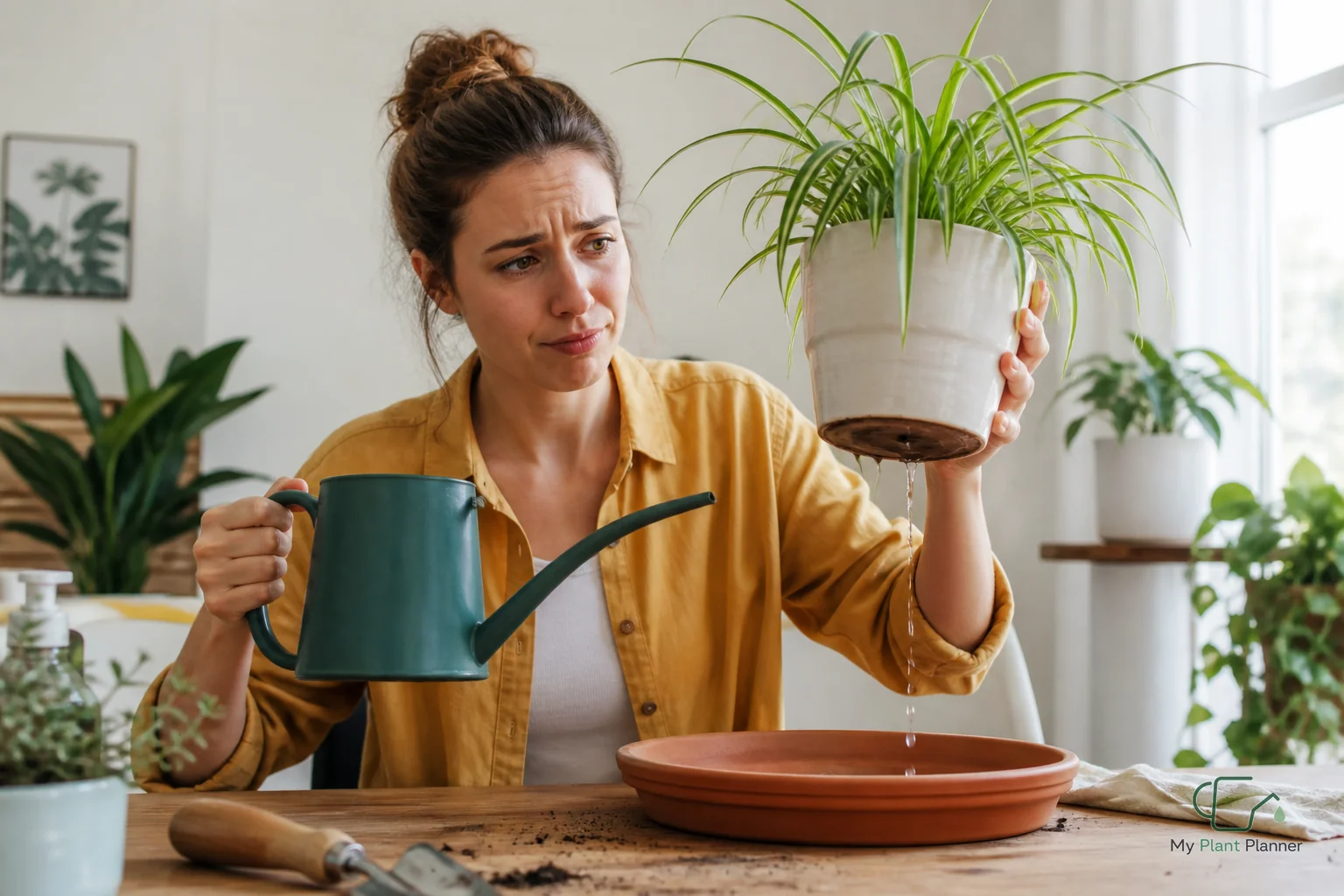
Spider plants are forgiving, but they are not magic. They can bounce back from a missed watering better than many leafy houseplants, yet they can still get into trouble if you keep watering on autopilot.
The goal is not to find one perfect watering day. The goal is to set a realistic check window, test the soil, water thoroughly when it is actually ready, then adjust after a couple of cycles.
The direct answer
For most indoor spider plants, start by checking the soil every 7 to 10 days in spring and summer, and every 10 to 14 days in fall and winter.
Indoors, that window can shift quickly if the plant is near a bright window, tucked into lower light, or sitting in a larger decorative pot.
That does not mean you should water every time you check. It means that is a reasonable window to test the pot.
Water when the top 1 to 2 inches of soil feel dry, the pot feels noticeably lighter, and the plant is not sitting in soggy mix from the last watering. If the soil still feels damp, wait a few more days and check again.
A spider plant in bright indirect light may be ready closer to the short end of that window. A spider plant in lower light, a large pot, or a cool room may need more time.
If you want a broader refresher on soil checks, read How to tell if an indoor plant needs water.
What changes the window
Spider plants are common, but indoor homes are not. The same plant can dry out in five days in one apartment and sit damp for two weeks in another.
Light level
More light usually means faster drying. A spider plant near a bright window, especially with indirect light for much of the day, will use water more actively.
Lower light slows everything down. Growth slows, evaporation slows, and the roots may not pull moisture from the soil as quickly. That is where fixed weekly watering gets people into trouble.
If light is confusing, this guide can help: How light level changes your indoor plant watering schedule.
Pot size
Small pots dry faster because there is less soil holding moisture. Large pots dry slower because the lower soil can stay damp long after the top looks dry.
This is especially important for spider plants because they are often sold as young plants in small nursery pots, then moved into decorative pots that are too roomy. Bigger is not always kinder. A pot that holds too much wet soil around the roots can make watering harder.
Drainage
A spider plant should not sit in standing water. Use a pot with drainage holes when possible. If it sits inside a decorative cachepot, remove the inner pot to water, let it drain, then put it back.
No drainage means the margin for error gets thin. You can still be careful, but you have to water less heavily and check more cautiously.
Season and indoor climate
In warm months, spider plants often grow more and dry faster. In winter, they usually slow down, especially in cooler rooms or away from strong light.
Heating and air conditioning also matter. Forced air can dry the top of the soil quickly while the lower soil stays moist. That is why finger checks and pot weight are more useful than staring at the surface.
Common spider plant watering mistakes
The first mistake is watering every Saturday because that is plant day. That routine feels organized, but the plant does not care what day it is.
The second mistake is giving tiny sips. A small splash may wet the top and leave the lower root zone dry. When the plant is ready, water thoroughly until excess drains out, then empty the saucer.
The third mistake is treating brown leaf tips as proof the plant needs more water. Brown tips can come from several causes, including inconsistent moisture, mineral buildup, dry air, or past stress. Do not diagnose from one symptom. Check the soil and the pot first.
The fourth mistake is leaving the plant in a pot that is too large. A spider plant with a small root system in a big container may stay wet longer than expected.
The fifth mistake is ignoring the first two watering cycles after moving the plant. New window, new pot, new season, new routine. Watch what actually happens before trusting the schedule.
Questions to check before watering
Ask these before you pour:
- Does the top 1 to 2 inches of soil feel dry?
- Does the pot feel lighter than it did right after watering?
- Is the plant in bright indirect light or lower light?
- Is the room warm and dry, or cool and still?
- Does the pot have drainage holes?
- Did the soil stay wet for a long time after the last watering?
- Has the plant recently been repotted into a bigger container?
If two or three answers point toward dry soil, it may be time to water. If the lower soil still feels damp or the pot feels heavy, wait.
A simple spider plant watering checklist
Use this as a starting routine:
- Set a check window of 7 to 10 days in spring and summer.
- Set a check window of 10 to 14 days in fall and winter.
- Push a finger into the top 1 to 2 inches of soil.
- Water only if that top layer is dry and the pot feels lighter.
- Water thoroughly when the plant is ready.
- Let extra water drain out fully.
- Empty the saucer or cachepot after watering.
- If the soil is still damp, wait 2 to 4 days and check again.
- After two or three cycles, shorten or lengthen the check window based on what you see.
This is boring in the best way. Boring watering is usually better than heroic plant rescue.
A safe way to adjust
If your spider plant is drying out too fast, shorten the check window by a couple of days. Also look at light, heat, airflow, and whether the plant is root crowded.
If it is staying wet too long, stretch the window. Check the pot size, drainage, and whether the plant is sitting in a dim corner.
Do not swing from one extreme to the other. Spider plants handle normal variation, but repeated soak and drought cycles can stress them.
Use the first schedule as a starting point, not a promise. Your room, pot, soil, and season decide the final rhythm.
Want a custom check window based on your plant, pot, light, season, and indoor climate? Try My Plant Planner.
Practical note
This article is general indoor plant care information. Watering windows are starting points, not guarantees. Your plant, pot, soil, light, season, and home climate can all change the right timing.
My Plant Planner gives general indoor plant-care guidance. Always check soil and plant condition before watering.