
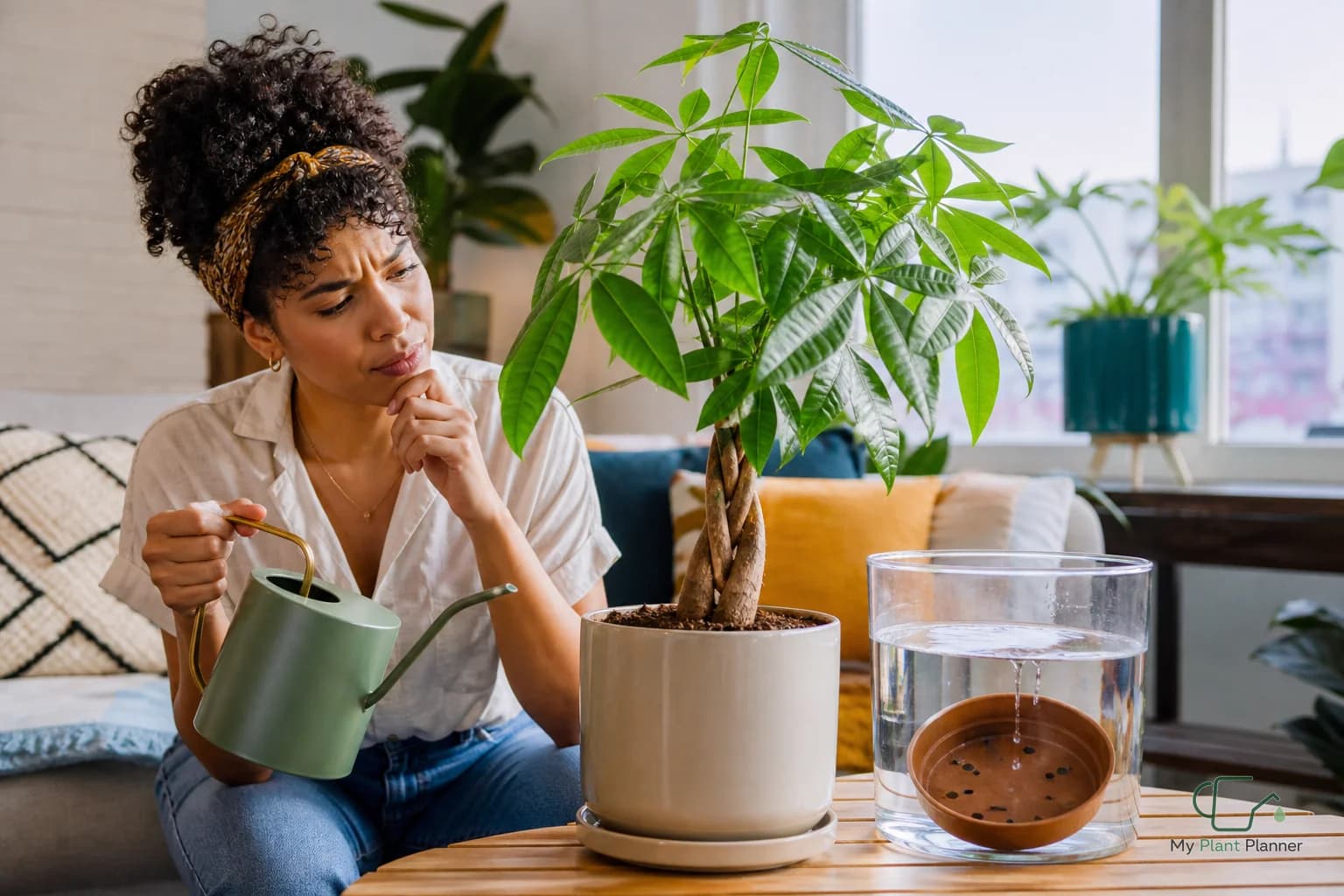
Money trees get sold as easy, lucky, low drama houseplants. Then people put them on a strict weekly watering schedule and wonder why the leaves yellow, droop, or fall off.
The plant is not being mysterious. A money tree can handle regular water, but indoors it hates sitting in a pot that stays wet for too long. The better plan is to set a watering check window, then confirm with the soil before you pour.
The direct answer
For most indoor money trees, start by checking the soil every 7 to 10 days in bright indirect light during active growth.
In medium light, a better starting check window is often every 10 to 14 days.
In lower light, cooler rooms, winter, or large pots, check closer to every 14 to 21 days.
That does not mean water every time the reminder appears. It means check. Water when the upper few inches of soil feel dry and the pot feels noticeably lighter than it did after the last full watering.
A money tree usually does better with a thorough watering followed by a real drying period than with tiny sips every few days. Water until excess drains from the bottom, then empty any saucer or outer pot. Wet roots trapped in a decorative cachepot are where the trouble starts.
If you want a broader framework, read How to set a watering check window for indoor plants. Money trees are a perfect example of why the reminder should tell you when to inspect, not when to automatically water.
What changes the check window
Light is the biggest driver. A money tree near a bright window uses water faster than one across the room. Bright indirect light can dry the pot steadily. Dim light slows growth and keeps the lower soil damp longer.
Pot size matters too. A small nursery pot may dry in a week. A large ceramic pot can stay damp below the surface long after the top looks dry. This is why the top inch test can trick you, especially in deeper containers.
Drainage changes everything. A pot with drainage holes gives extra water somewhere to go. A pot without drainage turns watering into a guessing game with higher stakes. If your money tree sits inside a decorative pot, always check that water is not pooling in the bottom.
Season also shifts the window. In spring and summer, warmer rooms and stronger light usually shorten the time between checks. In fall and winter, growth slows and soil often stays wet longer.
Indoor climate adds another layer. Heat vents, dry air, sunny windows, and small pots can speed drying. Cool rooms, humid rooms, dense soil, and oversized pots slow it down.
Common money tree watering mistakes
The first mistake is watering every Sunday because it feels responsible. Plants do not care about your calendar. They care about how much moisture is still around their roots.
The second mistake is watering because one leaf droops. A droopy money tree can be thirsty, but it can also be stressed from wet soil, low light, temperature swings, or a recent move. Leaf symptoms alone are not enough.
The third mistake is giving small sips. A splash on the surface may not reach the root zone evenly, especially if the soil has pulled away from the sides of the pot. Then part of the root ball stays dry while another part stays stale and damp.
The fourth mistake is trusting the braided trunk. The trunk can look firm while the soil is too wet, or look slightly wrinkled after a dry spell. It is useful context, not a water meter.
The fifth mistake is ignoring pot weight. Lifting the pot after watering and again when it is ready for water teaches you more than staring at leaves. If you have not used this method before, try How to use pot weight to decide when to water indoor plants.
Questions to check before watering
Ask these before you pour:
- Does the top few inches of soil feel dry, not just the surface?
- Does the pot feel lighter than it did after the last full watering?
- Is the plant in bright, medium, or low indoor light?
- Is it spring or summer, or is the plant in a slower winter period?
- Does the pot have drainage holes?
- Is water sitting in the saucer or decorative outer pot?
- Did the plant dry at this pace for the last two watering cycles?
That last question is underrated. One check tells you the condition today. Two or three checks reveal the pattern in your home.
A simple money tree watering checklist
Use this as your starting routine:
- Set a check window based on the room: 7 to 10 days for bright indirect light, 10 to 14 days for medium light, and 14 to 21 days for lower light or winter.
- On check day, feel below the surface instead of judging by the top crust alone.
- Lift the pot if you can. Heavy usually means wait. Noticeably lighter means keep checking.
- Water thoroughly only when the upper soil has dried and the pot has lightened.
- Let water drain fully from the bottom.
- Empty the saucer or cachepot after watering.
- Watch the next cycle. If the soil is still wet at the next check, lengthen the window.
- If the plant is drying much faster than expected, shorten the window or check for a very small pot, high heat, or strong light.
Adjust after a couple of cycles
Your first money tree watering window is only a starting point. The useful information comes after you watch how the pot behaves in your actual room.
If the soil is still damp when your reminder goes off, do not water out of guilt. Wait and check again in a few days. If the plant is dry much earlier than expected, move the next check closer.
A steady routine is not the same as a fixed schedule. The goal is to stop bouncing between soggy and bone dry.
If you want a quick starting window based on your plant, light, pot size, season, and indoor climate, use My Plant Planner. Treat it as a check reminder, then let the soil and pot weight make the final call.
Practical note
This article is general indoor plant care information. Watering windows are starting points, not guarantees. Your plant, pot, soil, light, season, and home climate can all change the right timing.
My Plant Planner gives general indoor plant-care guidance. Always check soil and plant condition before watering.